Basal fertilizer is applied before planting, before transplanting, or together with planting to supply nutrients close to the root zone during a crop’s first stage of growth. When the right product, rate, and application method are chosen, basal fertilization helps plants establish a stronger and more balanced start to the season.
Crop yield is not determined by a single fertilizer application. It depends on a nutrition program that reflects soil conditions, crop requirements, irrigation practices, and the production target. Basal fertilization is the first step of this program and can help supply phosphorus, nitrogen, potassium, sulfur, zinc, organic matter, and other nutrients when they are needed.
In this guide, we explain what basal fertilizer is, what it does, which types are available, and when and how it should be applied. We also outline how ARF Bio’s mineral, organomineral, and organic products can be assessed within a basal fertilization program.
What Is Basal Fertilizer?
Basal fertilizer is a plant nutrition product applied to the soil before planting, before transplanting, or at planting. Its purpose is to provide nutrients in or near the root zone while the plant is establishing its first roots and leaves.
Basal fertilizer is often associated with phosphorus because phosphorus is relatively immobile in soil and should be placed close to the developing root system. However, a well-designed basal fertilization program is not limited to phosphorus. Depending on soil analysis and crop needs, it may also include nitrogen, potassium, sulfur, zinc, organic matter, humic acids, and fulvic acids.
Basal fertilization does not replace the full seasonal nutrition program. Crops may still require top dressing, fertigation, or foliar nutrition as they develop. It should be considered the foundation of a balanced crop nutrition plan.
What Does Basal Fertilizer Do?
During germination, emergence, and early vegetative growth, a plant has a limited root system. Providing appropriate nutrients around the root zone during this stage can support root establishment and help the crop access water and nutrients more effectively later in the season.
Supports Early Plant Nutrition
Plants form new tissues quickly during emergence, seedling development, and early root growth. Basal fertilizer helps ensure that essential nutrients are available near the roots during this period and can reduce the risk of early nutrient deficiency.
Supports Root Development
Phosphorus is one of the key nutrients associated with root development. A broader and healthier root system can support access to water and nutrients. Placement is especially important in cool soils, where phosphorus uptake can be limited.
Helps Plants Access Nutrients
Placing nutrients close to the root zone can help young plants access them more efficiently. A suitable application method also supports efficient fertilizer use and can help reduce unnecessary losses in the soil.
Forms the Basis of Balanced Nutrition
Basal fertilization provides a framework for later top-dressing decisions. When soil analysis, previous crops, yield targets, and irrigation conditions are considered together, the first application can help create a more balanced nutrition program.
Which Nutrients Are Found in Basal Fertilizer?
The nutrient content of a basal fertilizer depends on its formulation. The NPK expression on fertilizer packaging indicates the nitrogen, phosphorus, and potassium content. Some formulations also include sulfur, zinc, organic matter, humic acids, and fulvic acids.
Nitrogen (N)
Nitrogen is a key macronutrient for leaf, stem, and shoot development. Nitrogen included in a basal fertilizer may support early crop growth. The final nitrogen rate should be planned according to crop type, soil properties, and the nitrogen to be supplied later through top dressing.
Phosphorus (P)
Phosphorus is important for root growth, energy transfer, and early plant development. Since its movement in soil is limited, placement near the root zone is preferred. DAP, NP, and NPK formulations are therefore commonly used in basal fertilization.
Potassium (K)
Potassium contributes to water regulation, plant tolerance to stress, and crop quality. A balanced NPK content may be especially important for crops with a high potassium requirement, including potatoes, sugar beet, vegetables, fruit trees, and some industrial crops.
Sulfur, Zinc, and Other Elements
Sulfur plays a role in protein synthesis and in the plant’s use of nitrogen. Zinc supports enzyme activity, root development, and early growth in some crops. Micronutrient requirements should be determined through soil analysis whenever possible.
Organic Matter and Humic and Fulvic Acids
Organic matter in organomineral and organic fertilizers can contribute to soil structure and water-holding capacity. Humic and fulvic acids may support nutrient behavior in the soil and biological activity around the root zone.
What Are the Types of Basal Fertilizer?
NP and NPK Compound Fertilizers
NP fertilizers contain nitrogen and phosphorus. NPK fertilizers combine nitrogen, phosphorus, and potassium. These products are used to place essential nutrients near the root zone before or at planting.
DAP 18-46-0
DAP 18-46-0 is a mineral NP fertilizer containing 18% nitrogen and 46% phosphorus. It is one of the commonly used products in basal fertilization, especially where phosphorus demand is high. Its rate should be determined by soil analysis and crop requirement.
Organomineral Basal Fertilizers
Organomineral basal fertilizers combine mineral nutrients with fermented organic matter. They can be considered in programs designed to support both plant nutrition and soil organic matter.
Organic Basal Fertilizers
Organic basal fertilizers can be included in programs aimed at improving soil organic matter. Nutrient release varies according to product composition and soil conditions. They may be planned together with mineral or organomineral fertilizers based on analysis results.
How Should Basal Fertilizer Be Chosen?
The same basal fertilizer is not suitable for every field. Fertilizer selection should be based on soil analysis, crop need, production target, and local growing conditions.
Base the Decision on Soil Analysis
Soil analysis shows pH, lime content, organic matter, salinity, phosphorus, potassium, and micronutrient status. Without these values, an application may fail to address the actual deficiency or may result in unnecessary fertilizer use.
Assess Crop Needs and Yield Target
Wheat, maize, sunflower, potato, vegetables, and fruit trees do not have identical nutrient needs. Even within the same crop, the fertilization program may change according to yield target, irrigation availability, and growing conditions.
Review Soil pH, Lime Content, and Organic Matter
In soils with high pH and lime content, phosphorus and some micronutrients may become less available to plants. In soils low in organic matter, products containing organic matter can be evaluated as part of the program.
Consider Previous Crops and All Nutrient Sources
Crop residues, farmyard manure, compost, irrigation water, and previous fertilizer applications all affect the nutrient budget. Ignoring these sources can lead to excessive or insufficient fertilization.
Read the Product Label
The guaranteed nutrient content, organic matter level, recommended application method, and intended use should be reviewed on the label. Check the following information before selecting a product:
- Nitrogen, phosphorus, and potassium content
- Organic matter and humic and fulvic acid content
- Sulfur, zinc, and other micronutrients
- Granular or liquid product form
- Recommended crop and application rate
- Compatibility with soil analysis results
- Registration and label information
- Availability of technical support
When Should Basal Fertilizer Be Applied?
Before Planting or Transplanting
Basal fertilizer may be broadcast during soil preparation and incorporated into the soil. The objective is to distribute the fertilizer evenly at an appropriate depth near the future root zone. Application should be avoided when the soil is too dry, too wet, frozen, or unsuitable for tillage.
At Planting or Transplanting
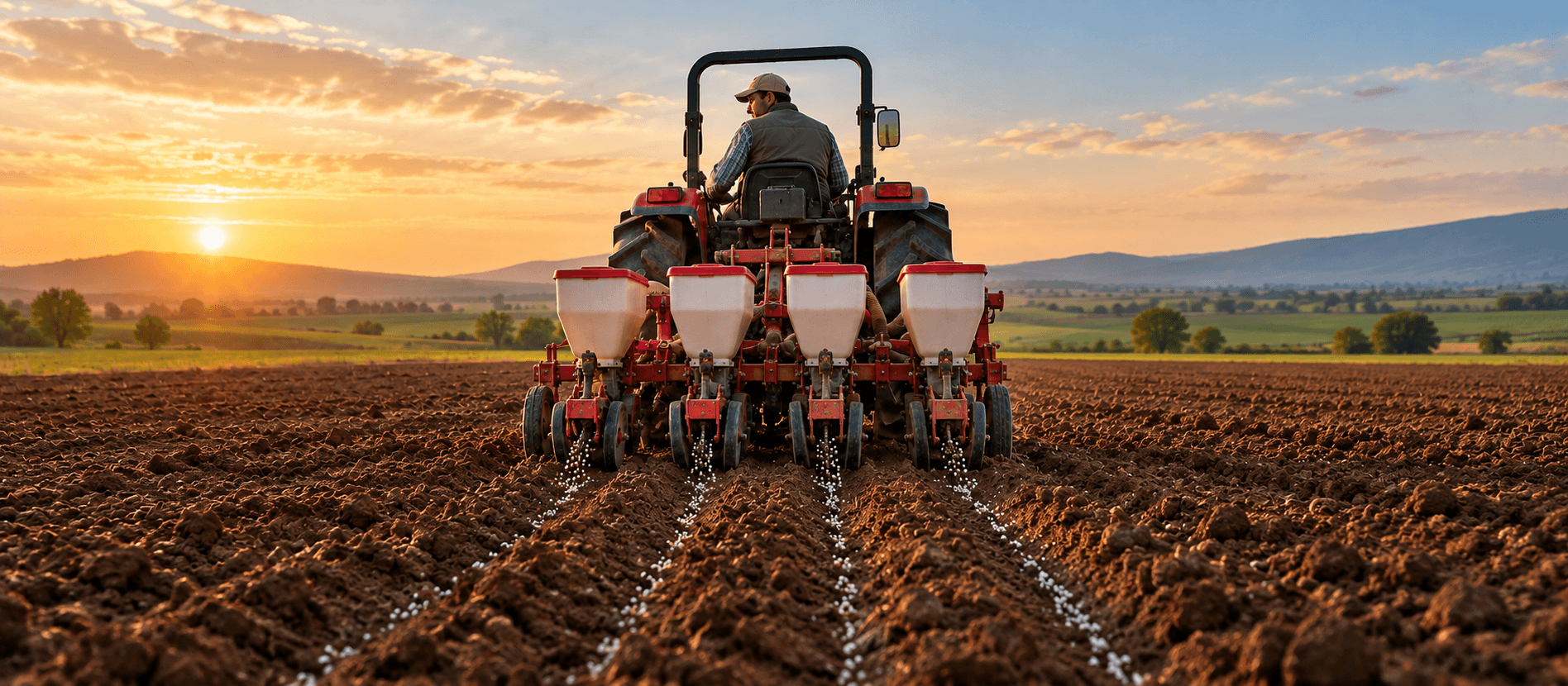
Band application with a planter or seeder places fertilizer near the seed row. Fertilizer should not come into direct contact with seeds, as this may create emergence and germination problems, especially with high-salt products.
Application in Perennial Crops
In orchards, vineyards, and olive groves, basal fertilizer is commonly applied by considering the root distribution area. Timing should be planned with an agricultural adviser according to local climate, crop growth stage, and soil analysis.
How Is Basal Fertilizer Applied?
Broadcast and Incorporation
Fertilizer is spread evenly over the soil surface and incorporated at a suitable depth with tillage equipment. This method can be used on large areas, provided that distribution and incorporation are uniform.
Band or Row Application
Fertilizer is placed in a band close to the seed or seedling row. This method can help improve early nutrient access, especially for phosphorus. A safe distance must be maintained between fertilizer and seed.
Planting Hole and Root-Zone Application
For seedlings and perennial crops, fertilizer may be applied around the root zone. It should not be placed in direct contact with roots. The fertilizer should be mixed with soil and supported by appropriate moisture conditions after application.
How Much Basal Fertilizer Should Be Applied?
There is no single correct basal fertilizer rate for every field. The rate should be determined by soil analysis, crop nutrient requirement, yield target, fertilizer nutrient percentage, and all other nutrient sources.
The following calculation can help when planning nutrient supply:
Nutrient supplied = Fertilizer amount × Nutrient percentage / 100
Fertilizer amount = Required nutrient amount × 100 / Nutrient percentage in the fertilizer
For example, applying 20 kg of DAP 18-46-0 supplies approximately 3.6 kg of nitrogen and 9.2 kg of P₂O₅. This is not a universal recommendation. Field-specific rates must be based on soil analysis and crop requirements.
What Is the Difference Between Basal and Top-Dressing Fertilizer?
| Feature | Basal Fertilizer | Top-Dressing Fertilizer |
|---|---|---|
| Application timing | Before planting, before transplanting, or at planting | During crop development |
| Main purpose | Support root growth and early nutrition | Meet nutrient demand during the season |
| Common content | Phosphorus, nitrogen, potassium, organic matter, and micronutrients | Nitrogen-focused or growth-stage-specific liquid and granular products |
| Application method | Broadcasting, incorporation, band, or row application | Broadcasting, fertigation, or foliar application |
| Planning basis | Soil analysis and planting plan | Crop growth status and seasonal conditions |
Mineral, Organomineral, and Organic Basal Fertilizers
| Fertilizer Type | General Feature | Role in Basal Fertilization |
|---|---|---|
| Mineral Fertilizer | Contains targeted nutrients in concentrated form | Used to meet specific N, P, and K requirements |
| Organomineral Fertilizer | Combines mineral nutrients with organic matter | Can be assessed in programs that support nutrition and soil structure together |
| Organic Fertilizer | Supports the physical and biological properties of soil through organic matter | Can be included where soil organic matter needs to be supported |
Which Crops Use Basal Fertilizer?
Cereals Such as Wheat and Barley
In cereals, basal fertilization is important for early root and plant development before tillering. Phosphorus, nitrogen, sulfur, and zinc requirements should be evaluated according to soil analysis.
Maize, Sunflower, and Cotton
These crops may have substantial nutrient needs when yield targets are high. The balance of phosphorus, potassium, and micronutrients in basal fertilizer should be planned crop by crop.
Potato and Sugar Beet
Potato and sugar beet are among the crops sensitive to potassium and balanced phosphorus nutrition. Basal fertilizer can be planned as the first step in a nutrition program supporting tuber and root development.
Vegetables
In tomatoes, peppers, cucumbers, melons, watermelons, and leafy vegetables, fertilizer planning should take account of irrigation method, soil conditions, and growing period. Basal fertilizer can support later fertigation applications.
Fruit Trees and Vines
For perennial crops, basal fertilization can be assessed for root-zone development, soil fertility, and pre-season nutrition planning. Timing and rate should be determined according to orchard age and soil analysis.
Common Basal Fertilizer Mistakes
Applying Fertilizer Without Soil Analysis
Applying fertilizer without knowing which nutrients are deficient can create unnecessary cost and upset nutrient balance.
Trying to Meet All Needs with One Product
No single product meets every nutrient need. Basal and top-dressing applications should be planned together, with organic and mineral sources balanced where needed.
Placing Fertilizer in Direct Contact with Seed
Direct seed contact with concentrated mineral fertilizers can cause germination problems. A safe distance should be maintained during band application.
Applying in Unsuitable Weather or Soil Conditions
Heavy rain, excessively dry soil, frost, runoff risk, and soil that is too wet to cultivate can reduce fertilizer effectiveness.
Using the Wrong Rate
Higher rates do not automatically mean higher yield. Excess fertilizer can increase salinity, create plant stress, cause economic loss, and increase environmental risk.
Ignoring Label and Technical Information
Product content, application guidance, and safety instructions should be reviewed carefully. Agricultural technical support should be sought where necessary.
Overlooking Organic Matter
Soil is more than a source of mineral nutrients. Organic matter is important for water retention, aeration, root development, and nutrient behavior. Its status should be considered in every fertilizer program.
Basal Fertilization with ARF Bio Products
ARF Bio’s mineral, organomineral, and organic products can be evaluated in different soil and crop nutrition programs. Product choice and application rate should be determined through soil analysis and technical advice.
| Product | Product Type | Key Content |
|---|---|---|
| ARF BIO 8-21-0 | NP Solid Organomineral Fertilizer | 8% N, 21% P₂O₅, 20% organic matter, 5% total humic and fulvic acids, 0.1% Zn |
| ARF BIO 11-11-11 + 10 SO₃ | NPK Solid Organomineral Fertilizer | 11-11-11 NPK, 10% SO₃, 15% organic matter, 5% total humic and fulvic acids, 0.1% Zn |
| ARF BIO 6-16-6 + 10 SO₃ | NPK Solid Organomineral Fertilizer | 6-16-6 NPK, 10% SO₃, 15% organic matter, 5% total humic and fulvic acids, 0.1% Zn |
| ARF DAP 18-46-0 | Mineral NP Fertilizer | 18% N, 46% P₂O₅, 41% water-soluble P₂O₅ |
| ARF BIO | Fermented Organic Fertilizer | 60% organic matter, 1% N, 1% P₂O₅, 20% total humic and fulvic acids |
| ARF BIO PLUS | Fermented Organic Fertilizer | 50% organic matter, 3% N, 1% P₂O₅, 1% K₂O, 15% total humic and fulvic acids |
ARF BIO 8-21-0 can be assessed for basal fertilization programs that require phosphorus and organic matter together. Its zinc content may also be relevant where soil analysis indicates zinc deficiency.
ARF BIO 11-11-11 + 10 SO₃ provides balanced nitrogen, phosphorus, and potassium in an organomineral structure. It can be considered where a balanced NPK supply with sulfur is required.
ARF BIO 6-16-6 + 10 SO₃ has a phosphorus-focused content with organic matter support and can be assessed in programs targeting root-zone nutrition.
ARF DAP 18-46-0 can be used as a mineral NP source where phosphorus requirements are identified through soil analysis.
ARF BIO and ARF BIO PLUS can be included where a program aims to support soil organic matter with fermented organic inputs. Soil analysis and technical assessment should guide product selection and rate.
Frequently Asked Questions About Basal Fertilizer
How Many Days Before Planting Should Basal Fertilizer Be Applied?
Basal fertilizer may be applied during soil preparation shortly before planting or transplanting. The timing depends on the product form, tillage method, and weather conditions. Applying it at planting through band placement is also common.
Is DAP a Basal Fertilizer?
DAP 18-46-0 is commonly used as a basal fertilizer because of its phosphorus content. However, the same rate should not be used in every field. Phosphorus need should be determined through soil analysis.
Can Organomineral Fertilizer Be Used as Basal Fertilizer?
Organomineral products with suitable content and label recommendations can be used in basal fertilization. They may be considered where both mineral nutrition and soil organic matter support are desired.
Can Basal Fertilizer Be Applied with Seed?
Fertilizer can be placed near seed through a planter or seeder. Direct seed contact should be avoided. The safe placement distance should follow product guidance and equipment settings.
How Many Kilograms of Basal Fertilizer per Decare?
The required rate changes according to fertilizer content and soil need. A universal rate should not be used. Soil analysis, yield target, and product label should be assessed together.
Should Basal Fertilizer Be Applied Before Rain?
Suitable soil moisture after application can help nutrients dissolve. However, applications should be planned carefully where heavy rainfall, runoff, or leaching risk is expected.
Can Basal Fertilizer Replace Top Dressing?
No. Basal fertilizer is intended for early crop nutrition. Crops may require additional nutrition through top dressing as they continue to develop.
Can Basal Fertilizer Burn Roots or Seeds?
Incorrect rates, direct contact, or unsuitable conditions can create plant injury risk. Follow label instructions and avoid direct contact between fertilizer and seed.
Can Basal Fertilizer Be Used with Farmyard Manure?
It can be used together when soil analysis and manure composition are considered. Because nutrient content in farmyard manure varies, the total nutrient budget should be calculated.
When Should Basal Fertilizer Be Applied to Fruit Trees?
Timing depends on local climate, soil conditions, and crop development stage. Planning is commonly carried out from late winter to early spring. Orchard analysis and technical advice should guide the final decision.
A Strong Start with the Right Basal Fertilizer
Basal fertilization is an important first step for healthy root development and a balanced crop nutrition program. Fertilizer efficiency can improve when soil analysis, crop needs, climate conditions, and the correct application method are evaluated together.
ARF Bio combines fermented organic matter from its biogas process with mineral nutrients to offer organic, organomineral, and mineral fertilizer solutions. To select a product and rate suitable for your field, assess your soil analysis together with an agricultural engineer.